

- Market Size (2026)
- USD 11.5 Bn
- Forecast (2036)
- USD 23.1 Bn
- CAGR (2026 to 2036)
- 7.2%
Porcelain Tableware Market Size, Market Forecast and Outlook By FMI
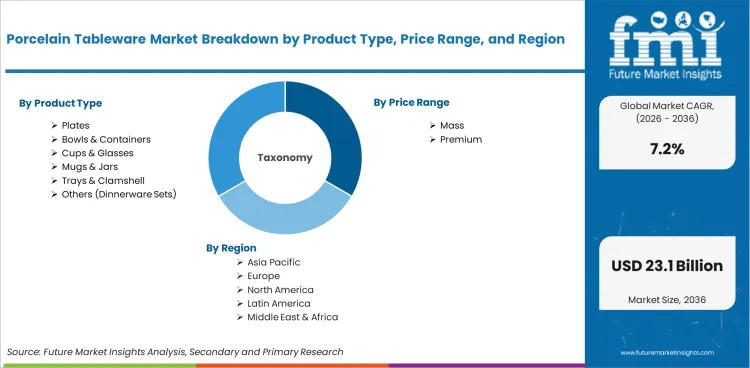
The porcelain tableware market was valued at USD 10.8 billion in 2025. The market is set to reach USD 11.5 billion by 2026-end and grow at a CAGR of 7.2% between 2026-2036 to reach USD 23.1 billion by 2036. Plates will dominate with a 31.8% share, while Mass will lead with a 62.4% share.
Summary of the Porcelain Tableware Market
- Demand and Growth Drivers
- Hospitality industry expansion, including restaurant openings, hotel construction, and catering operations, sustains institutional procurement of durable porcelain tableware for commercial food service applications.
- Consumer premiumization in home dining, driven by interest in entertaining, gifting occasions, and lifestyle media influence, is supporting retail demand for branded porcelain tableware sets and individual accent pieces.
- E-commerce penetration in home goods retail is expanding consumer access to porcelain tableware brands and designs beyond traditional department store and specialty retail distribution limitations.
- Product and Segment View
- Plates hold 31.8% of the Product Type segment in 2026, reflecting the central role of dinner plates, salad plates, and charger plates as the primary tableware items purchased in both consumer retail and hospitality procurement.
- Glazed Porcelain accounts for 66.2% of the Product Finish segment, reflecting the dominant consumer and hospitality preference for glazed finishes that provide smooth surface texture, stain resistance, and decorative versatility.
- HORECA at 54.7% of the Distribution Channel segment reflects the primary retail format and purchasing occasion for porcelain tableware consumer sales.
- Geography and Competitive Outlook
- South Korea leads growth at 7.6% CAGR through 2036, reflecting domestic scale and expanding infrastructure.
- USA at 7.5% reflects sustained demand from established channels.
- Companies with leading portfolios and multi regional capability maintain the strongest positions.
- Analyst Opinion
- Rahul Pandita, Principal Consultant at FMI says, 'Porcelain tableware manufacturers that combine heritage brand positioning with contemporary design, sustainable production credentials, and omnichannel distribution will capture the widest consumer base as purchasing migrates from department stores toward specialty retail and e-commerce. The hospitality sector represents the highest volume procurement channel, where operators prioritize durability, chip resistance, and efficient logistics over design exclusivity, creating distinct competitive dynamics from consumer retail.'
- The porcelain tableware market is transitioning toward more structured procurement and supply chain relationships.
- Adoption is increasing due to evolving regulatory requirements and commercial benchmarks.
- Demand is further supported by evolving standards across North America, Europe, and East Asia.
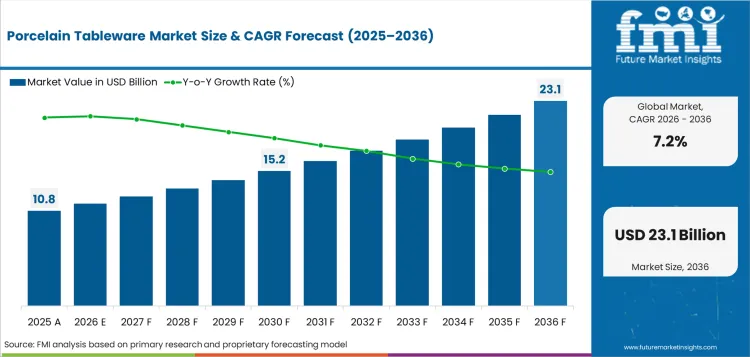
Key Takeaways, Market Size, and Forecast
| Metric | Value |
|---|---|
| Market Size (2025) | USD 10.83 Billion |
| Market Size (2036) | USD 23.10 Billion |
| CAGR (2026–2036) | 7.2% |
| Incremental Opportunity (2026–2036) | USD 11.58 Billion |
| Leading Product Type (2026) | Plates |
| Plates Share (2026) | 31.8% |
| Fastest-Growing Country | South Korea |
| South Korea CAGR | 7.6% |
| 2nd Fastest-Growing Country | USA |
| USA CAGR | 7.5% |
Porcelain Tableware Market Definition
The porcelain tableware market encompasses commercially manufactured porcelain dining and serving products, including plates, bowls, cups, mugs, serving dishes, and decorative tableware items. Products include both consumer retail and hospitality grade porcelain in glazed and unglazed finishes.
Porcelain Tableware Market Inclusions
Market scope covers all commercially traded products categorized by Product Type, Price Range, Distribution Channel, Application, Product Finish, Sales Channel. Revenue sizing spans the 2026 to 2036 forecast period and includes products sold through department stores, specialty retail, e-commerce, hospitality supply channels, and direct to consumer platforms globally.
Porcelain Tableware Market Exclusions
The scope does not include ceramic stoneware or earthenware tableware, disposable or single use tableware, melamine or plastic dinnerware, glass tableware, or porcelain decorative objects not designed for dining use.
Porcelain Tableware Market Research Methodology
- Primary Research: FMI analysts conducted interviews with manufacturers, specialists, and participants across key markets.
- Desk Research: Combined industry databases, regulatory filings, publications, and manufacturer disclosures.
- Market Sizing and Forecasting: Bottom up aggregation across segments, applications, and regions with adoption curve modeling.
- Data Validation: Cross checked quarterly against statistics, trade data, and reported figures.
Why is the Porcelain Tableware Market Growing?
- The continued growth of the hospitality industry and the expansion of commercial food service are helping to keep the institutional purchase of porcelain tableware in areas where durability, chip resistance and microwave/dishwasher compatibility are the key criteria for selection.
- Consumer demand for branded porcelain tableware is being supported by elevated dining aesthetics and lifestyle media influence, and is moving beyond replacement purchasing, as interest in home entertaining increases.
- South Korea (7.6%) and the USA (7.5%) are experiencing the fastest growth, driven by high consumer awareness of design, growth in the hospitality industry, and well-established retail channels for upscale home furnishings.
The expanding porcelain tableware market is witnessing combined growth in institutional and household segments supported by consumer retail demand and hospitality procurement. The product type segment is comprised of 31.8% plates, the key tableware item that forms the basis for both overall dinnerware set purchases and individual piece selection. Bowls, cups and mugs, serving pieces and decorative items fuel complementary revenue across the product portfolio.
Hospitality procurement is the highest volume purchasing avenue. Commercial operators rank durability metrics such as chip resistance, thermal shock tolerance and stackability over decorative design exclusivity. Hospitality grade porcelain is manufactured to withstand commercial dish washing and microwave use. This is a different product spec than consumer retail porcelain. Contract procurement relationships between porcelain manufacturers and hotel/restaurant groups offer predictable volume demand but with lower per unit margins than consumer retail.
Consumer retail is moving from department store dominated distribution to specialty home goods retailers, direct to consumer e-commerce and lifestyle brand collaborations. Younger consumers are being influenced by social media and home design content as dining presentation is becoming a lifestyle expression category impacting tableware purchase decisions. This trend is consistent with premiumization via limited edition designs, designer collaborations and artisanal production positioning that commands higher retail prices than standard production porcelain.
Market Segmentation Analysis
- Plates holds 31.8% of the Product Type segment.
- Glazed Porcelain accounts for 66.2% of the Product Finish segment.
- HORECA at 54.7% of the Distribution Channel segment reflects functional preferences.
The porcelain tableware market is segmented by Product Type, Price Range, Distribution Channel, Application, Product Finish, Sales Channel.
Insights into the Plates Product Type Segment
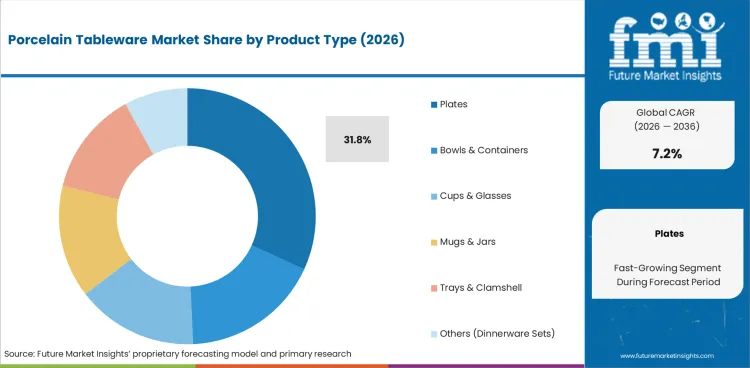
In 2026, Plates is expected to account for 31.8% of the Product Type segment. This reflects sustained demand where plates has demonstrated consistent performance. Sub segments are differentiated by specifications and pricing. Procurement decisions prioritize reliability, compliance, and quality.
Insights into the Glazed Porcelain Product Finish Segment
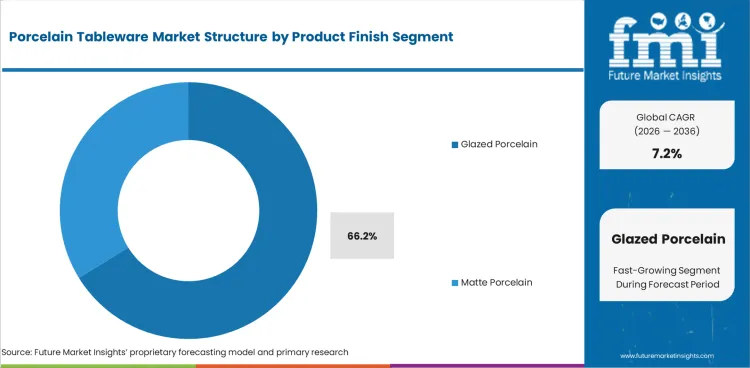
Glazed Porcelain accounts for 66.2% of the Product Finish segment. Growth is supported by expanding markets and standardization. Buyers prioritize performance, cost considerations, and support.
Porcelain Tableware Market Drivers, Restraints, and Opportunities
- Regulatory frameworks generate structured demand for compliant products.
- Margin risk from cost pressures and supply constraints.
- Application expansion offers incremental growth opportunities.
The market for porcelain tableware is driven by regulatory requirements, changing demands and competitive landscape.
Hospitality Industry Expansion and Institutional Procurement
Demand is created by the ongoing growth of restaurant, hotel and catering business, resulting in institutional purchasing of durable porcelain tableware. Each new hospitality venue requires a full tableware inventory sized to its seating capacity and service format, with a continual replacement need driven by breakage rates and shifts to menu format.
Import Competition and Manufacturing Cost Pressure
Competitive pressure from lower cost porcelain manufacturers in China and Southeast Asia offering price competitive alternatives to European and Japanese heritage brands is constraining growth. Cost-conscious hospitality purchasers and mass market retailers are increasingly sourcing from Asian manufacturers, putting pressure on margins for traditional European porcelain producers.
Consumer Premiumization and Lifestyle Positioning
Consumers’ willingness to invest in premium tableware as an expression of their dining lifestyle and home aesthetics is driving increased adoption. The impact of social media on the culture of home entertaining, the upgrading of wedding registries and gifting occasions underpin the premium price points of branded and designer porcelain tableware in consumer retail channels.
E-commerce Distribution and Direct to Consumer Growth
Growth is driven by the expansion of online tableware retail, bringing porcelain brands and designs to a wider consumer base. Direct to consumer e-commerce allows manufacturers to capture full retail margins and build direct customer relationships. The hesitation to buy tableware digitally is decreasing with online visualization tools that show tableware in table setting contexts for products that are usually evaluated by physical handling.
Analysis of Porcelain Tableware Market By Key Countries
.webp "Top Country Growth Comparison Porcelain Tableware Market Cagr (2026 2036)")
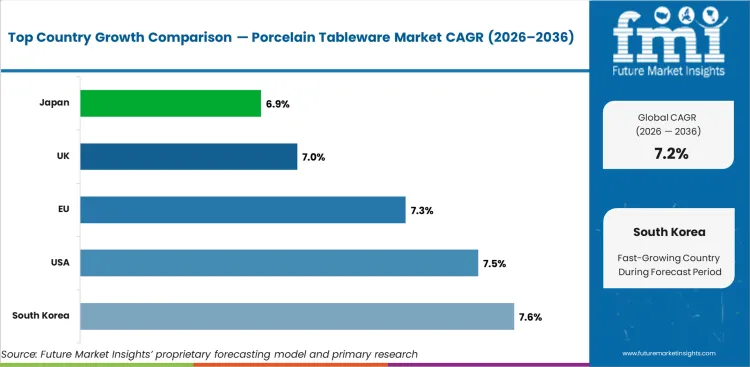
| Country | CAGR |
|---|---|
| USA | 7.5% |
| UK | 7% |
| EU | 7.3% |
| Japan | 6.9% |
| South Korea | 7.6% |
- South Korea leads with 7.6% CAGR through 2036.
- USA at 7.5% demonstrates sustained demand.
- UK (7%) reflects stable demand.
The global porcelain tableware market is projected to grow at 7.2% CAGR from 2026 to 2036, covering more than 30 countries.
Demand Outlook for Porcelain Tableware Market in the United States
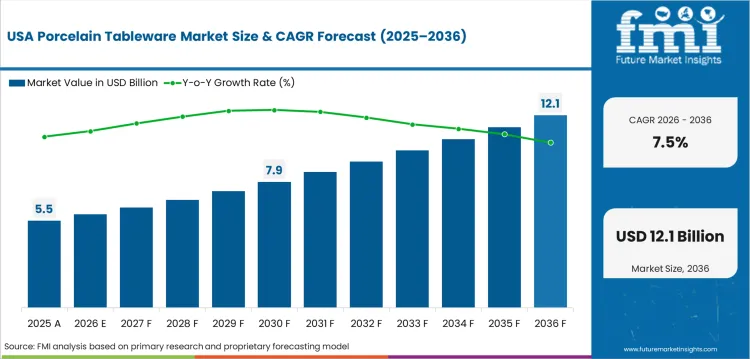
The United States is expected to grow at 7.5% CAGR through 2036. US demand is sustained by hospitality industry procurement for restaurant and hotel tableware inventories, combined with consumer retail purchasing through department stores, specialty home goods retailers like Williams-Sonoma and Crate & Barrel, and growing direct to consumer e-commerce channels that provide access to both domestic and international porcelain brands.
- Hospitality industry procurement sustains institutional tableware volumes.
- Specialty home goods retailers provide premium consumer retail distribution.
- Wedding registry and gifting culture drives occasion based tableware purchasing.
Future Outlook for Porcelain Tableware Market in the United Kingdom
The United Kingdom is expected to grow at 7.0% CAGR through 2036. British porcelain heritage brands including Royal Doulton, Wedgwood, and Emma Bridgewater maintain strong domestic market positions, with gifting culture, aspirational home entertaining trends, and hospitality industry procurement sustaining demand across both consumer retail and institutional channels.
- Heritage porcelain brands maintain strong domestic market positions and brand loyalty.
- Gifting and wedding registry culture sustains occasion based purchasing.
- Hospitality industry procurement for restaurants and hotels provides institutional demand.
Opportunity Analysis for Porcelain Tableware Market in the European Union
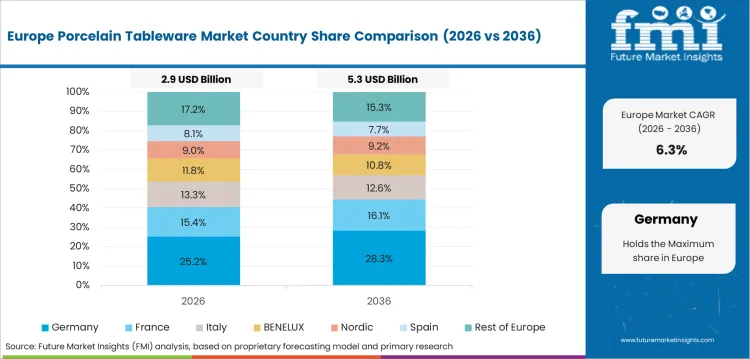
The European Union is expected to grow at 7.3% CAGR through 2036. European porcelain manufacturing heritage, centered in Germany (Meissen, Rosenthal), France (Limoges), and the Netherlands (Royal Delft), sustains premium brand positioning, with EU food contact material safety regulations providing a harmonized quality framework that supports consumer confidence in European produced tableware.
- European porcelain manufacturing heritage sustains premium global brand positioning.
- EU food contact regulations provide harmonized safety and quality framework.
- Hospitality sector across European tourism destinations sustains institutional procurement.
In-depth Analysis of Porcelain Tableware Market in Japan
Japan is expected to grow at 6.9% CAGR through 2036. Japan's Arita, Hasami, and Kutani porcelain traditions sustain a domestic market where craftsmanship heritage, seasonal tableware rotation customs, and the cultural importance of food presentation create demand patterns that support both mass produced and artisanal porcelain products at premium price points.
- Arita, Hasami, and Kutani porcelain traditions sustain craftsmanship heritage demand.
- Seasonal tableware rotation customs generate regular repurchasing patterns.
- Cultural importance of food presentation supports premium tableware investment.
Sales Analysis of Porcelain Tableware Market in South Korea
South Korea is expected to grow at 7.6% CAGR through 2036. South Korea's growing home entertaining culture, influenced by social media food presentation trends and K-drama lifestyle aspirations, is creating demand for premium porcelain tableware brands, with online retail platforms and department stores providing primary distribution channels for both domestic and imported products.
- Home entertaining culture driven by social media and K-drama creates premium demand.
- Online retail platforms provide efficient access to domestic and international brands.
- Department store tableware departments serve premium gifting and self purchase.
Competitive Landscape and Strategic Positioning
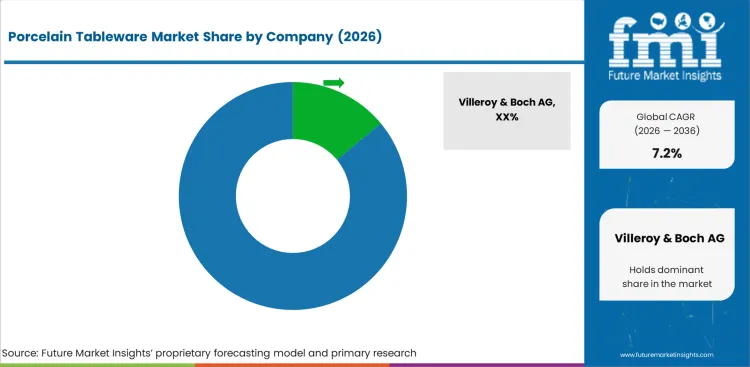
- Villeroy & Boch AG maintains the strongest position.
- Rosenthal GmbH, Fiskars Group (Royal Doulton, Wedgwood), Lenox Corporation compete through specialization.
- Emerging players focus on niche differentiation.
Villeroy & Boch AG holds the strongest competitive position through technical capability, established relationships, and portfolio breadth.
Rosenthal GmbH, Fiskars Group (Royal Doulton, Wedgwood), Lenox Corporation compete through specialized capabilities and targeted strategies.
Barriers to entry include technical expertise, regulatory compliance, established relationships, and capital requirements.
Strategic priorities include cost optimization, geographic expansion, portfolio extension, and customer retention.
Key Companies in the Porcelain Tableware Market
Key global companies leading the porcelain tableware market include:
- Villeroy & Boch AG, Rosenthal GmbH, Fiskars Group (Royal Doulton, Wedgwood), Lenox Corporation maintain strong positions through integrated capabilities.
- Churchill China plc, Noritake Co., Limited, BHS Tabletop AG compete through regional specialization.
- Degrenne Paris, Vista Alegre Atlantis, Haviland & Cie, Other Key Players are establishing presence through niche focus.
Competitive Benchmarking: Porcelain Tableware Market
| Company | Brand Heritage | Design Capability | Hospitality Access | Distribution Reach |
|---|---|---|---|---|
| Villeroy & Boch AG | High | High | Strong | Global |
| Rosenthal GmbH | High | High | Strong | Global |
| Fiskars Group (Royal Doulton, Wedgwood) | High | High | Strong | Global |
| Lenox Corporation | Medium | High | Moderate | Global |
| Churchill China plc | Medium | Medium | Moderate | Regional |
| Noritake Co., Limited | Medium | Medium | Moderate | Regional |
| BHS Tabletop AG | Low | Medium | Low | Regional |
| Degrenne Paris | Low | Medium | Low | Niche |
| Vista Alegre Atlantis | Low | Medium | Low | Niche |
| Haviland & Cie | Low | Medium | Low | Niche |
Source: Future Market Insights competitive analysis, 2026.
Key Developments in Porcelain Tableware Market
- In 2025, Villeroy & Boch AG expanded its premium tableware portfolio by introducing new collections with reactive-effect glazes, targeting the growing demand for artisan-style glazed porcelain and stoneware with handcrafted, organic aesthetics.
- In 2025, Rosenthal GmbH expanded its premium porcelain portfolio through new luxury collections and strategic brand collaborations, strengthening its position in the global high-end tableware market.
Key Players in the Porcelain Tableware Market
Major Global Players
- Villeroy & Boch AG
- Rosenthal GmbH
- Fiskars Group (Royal Doulton, Wedgwood)
- Lenox Corporation
- Churchill China plc
- Noritake Co., Limited
- BHS Tabletop AG
Emerging Players/Startups
- Degrenne Paris
- Vista Alegre Atlantis
- Haviland & Cie
- Other Key Players
Report Scope and Coverage
| Parameter | Details |
|---|---|
| Quantitative Units | USD 11.53 billion to USD 23.10 billion, at a CAGR of 7.2% |
| Market Definition | The porcelain tableware market encompasses commercially traded products categorized by Product Type, Price Range, Distribution Channel, Application, Product Finish, Sales Channel. |
| Regions Covered | North America, Latin America, Europe, East Asia, South Asia and Pacific, Middle East and Africa |
| Countries Covered | USA, UK, EU, Japan, South Korea, 30 plus countries |
| Key Companies Profiled | Villeroy & Boch AG, Rosenthal GmbH, Fiskars Group (Royal Doulton, Wedgwood), Lenox Corporation, Churchill China plc, Noritake Co., Limited, BHS Tabletop AG, Degrenne Paris, Vista Alegre Atlantis, Haviland & Cie, Other Key Players |
| Forecast Period | 2026 to 2036 |
| Approach | Hybrid bottom up and top down methodology starting with verified transaction data, projecting adoption velocity across segments and regions. |
Segmentation
Porcelain Tableware Market Segmented by Product Type:
- Plates
- Dinner Plates
- Side & Dessert Plates
- Bowls & Containers
- Serving Bowls
- Storage Containers
- Cups & Glasses
- Tea & Coffee Cups
- Porcelain Drinkware Sets
- Mugs & Jars
- Coffee Mugs
- Storage Jars
- Trays & Clamshell
- Serving Trays
- Catering Clamshell Packaging
- Others (Dinnerware Sets)
- Complete Tableware Sets
- Luxury Porcelain Sets
Porcelain Tableware Market Segmented by Price Range:
- Mass
- Affordable Household Tableware
- Bulk Hospitality Supplies
- Premium
- Luxury Dining Collections
- Designer Porcelain Tableware
Porcelain Tableware Market Segmented by Distribution Channel:
- HORECA
- Hotels & Fine Dining Restaurants
- Cafés & Catering Services
- Residential/Households
- Retail Household Purchases
- Home Dining & Kitchen Use
Porcelain Tableware Market Segmented by Application:
- Hospitality Use
- Hotel Dining & Banquet Services
- Restaurant Table Settings
- Household Use
- Daily Dining Tableware
- Home Entertaining & Serving
- Institutional Use
- Corporate Cafeterias
- Educational & Healthcare Facilities
Porcelain Tableware Market Segmented by Product Finish:
- Glazed Porcelain
- Glossy Finish Tableware
- Stain & Scratch Resistant Coatings
- Matte Porcelain
- Modern Minimalist Designs
- Textured Surface Tableware
Porcelain Tableware Market Segmented by Sales Channel:
- Offline Retail
- Specialty Kitchenware Stores
- Departmental Stores
- Online Retail
- E-commerce Marketplaces
- Brand-Owned Websites
- Direct Sales
- Bulk Hospitality Contracts
- Institutional Procurement
Porcelain Tableware Market by Region:
- North America
- USA
- Canada
- Mexico
- Latin America
- Brazil
- Chile
- Rest of Latin America
- Western Europe
- Germany
- UK
- Italy
- Spain
- France
- Nordic
- BENELUX
- Rest of Western Europe
- Eastern Europe
- Russia
- Poland
- Hungary
- Balkan & Baltic
- Rest of Eastern Europe
- East Asia
- China
- Japan
- South Korea
- South Asia and Pacific
- India
- ASEAN
- Australia & New Zealand
- Rest of South Asia and Pacific
- Middle East & Africa
- Kingdom of Saudi Arabia
- Other GCC Countries
- Turkiye
- South Africa
- Other African Union
- Rest of Middle East & Africa
Research Sources and Bibliography
- 1. European Ceramic Industry Association. (2025). Cerame-Unie Annual Report: European Porcelain Production Statistics. Cerame-Unie.
- 2. World Trade Organization. (2025). WTO International Trade Statistics: Ceramic Tableware Trade Data. WTO.
- 3. International Organization for Standardization. (2025). ISO 7086: Household Ceramic Tableware Performance Standards. ISO.
- 4. European Commission. (2024). EU Product Safety Regulation: Ceramic Food Contact Materials. EC.
- 5. World Bank. (2025). World Bank Consumer Goods Trade and Manufacturing Report. World Bank.
This bibliography is provided for reader reference. The full Future Market Insights report contains the complete reference list with publication dates, URLs, and supporting data for all cited works.
This Report Addresses
- Estimating market size and revenue from 2026 to 2036.
- Segmentation by product, application, end use, and region.
- Insights about more than 30 regional markets.
- Technology, manufacturing, and supply chain analysis.
- Competitive landscape assessment.
- Investment opportunity identification.
- Supply chain and distribution analysis.
- Data delivery in PDF and Excel formats.
Frequently Asked Questions
What is the global market demand for Porcelain Tableware Market in 2026?
In 2026, the global porcelain tableware market is expected to be worth USD 11.53 billion.
How big will the Porcelain Tableware Market be in 2036?
By 2036, the porcelain tableware market is expected to reach USD 23.10 billion.
How much is demand for Porcelain Tableware Market expected to grow between 2026 and 2036?
Between 2026 and 2036, demand is expected to grow at a CAGR of 7.2%.
Which Product Type is expected to lead in the Porcelain Tableware Market in 2026?
Plates is expected to account for 31.8% of the Product Type segment in 2026.
What is causing demand to rise in South Korea in the Porcelain Tableware Market?
South Korea is expected to grow at 7.6% CAGR through 2036, supported by domestic scale and favorable conditions.
What is causing demand to rise in USA in the Porcelain Tableware Market?
USA is expected to grow at 7.5% CAGR through 2036, driven by established infrastructure.
What does this report mean by 'Porcelain Tableware Market definition'?
The porcelain tableware market includes all commercially traded products categorized by Product Type, Price Range, Distribution Channel, Application, Product Finish, Sales Channel.
How does FMI make the Porcelain Tableware Market forecast?
Forecasting uses a hybrid bottom up and top down approach, starting with verified data and validating against industry statistics.
Preview the report firsthand - request a free sample
Get SampleGet the brochure for pricing and purchase details.
Get PDFTable of Content
- Executive Summary
- Global Market Outlook
- Demand-side Trends
- Supply-side Trends
- Technology Roadmap Analysis
- Analysis and Recommendations
- Market Overview
- Market Coverage / Taxonomy
- Market Definition / Scope / Limitations
- Research Methodology
- Chapter Orientation
- Analytical Lens and Working Hypotheses
- Market Structure, Signals, and Trend Drivers
- Benchmarking and Cross-market Comparability
- Market Sizing, Forecasting, and Opportunity Mapping
- Research Design and Evidence Framework
- Desk Research Programme (Secondary Evidence)
- Company Annual and Sustainability Reports
- Peer-reviewed Journals and Academic Literature
- Corporate Websites, Product Literature, and Technical Notes
- Earnings Decks and Investor Briefings
- Statutory Filings and Regulatory Disclosures
- Technical White Papers and Standards Notes
- Trade Journals, Industry Magazines, and Analyst Briefs
- Conference Proceedings, Webinars, and Seminar Materials
- Government Statistics Portals and Public Data Releases
- Press Releases and Reputable Media Coverage
- Specialist Newsletters and Curated Briefings
- Sector Databases and Reference Repositories
- FMI Internal Proprietary Databases and Historical Market Datasets
- Subscription Datasets and Paid Sources
- Social Channels, Communities, and Digital Listening Inputs
- Additional Desk Sources
- Expert Input and Fieldwork (Primary Evidence)
- Primary Modes
- Qualitative Interviews and Expert Elicitation
- Quantitative Surveys and Structured Data Capture
- Blended Approach
- Why Primary Evidence is Used
- Field Techniques
- Interviews
- Surveys
- Focus Groups
- Observational and In-context Research
- Social and Community Interactions
- Stakeholder Universe Engaged
- C-suite Leaders
- Board Members
- Presidents and Vice Presidents
- R&D and Innovation Heads
- Technical Specialists
- Domain Subject-matter Experts
- Scientists
- Physicians and Other Healthcare Professionals
- Governance, Ethics, and Data Stewardship
- Research Ethics
- Data Integrity and Handling
- Primary Modes
- Tooling, Models, and Reference Databases
- Desk Research Programme (Secondary Evidence)
- Data Engineering and Model Build
- Data Acquisition and Ingestion
- Cleaning, Normalisation, and Verification
- Synthesis, Triangulation, and Analysis
- Quality Assurance and Audit Trail
- Market Background
- Market Dynamics
- Drivers
- Restraints
- Opportunity
- Trends
- Scenario Forecast
- Demand in Optimistic Scenario
- Demand in Likely Scenario
- Demand in Conservative Scenario
- Opportunity Map Analysis
- Product Life Cycle Analysis
- Supply Chain Analysis
- Investment Feasibility Matrix
- Value Chain Analysis
- PESTLE and Porter’s Analysis
- Regulatory Landscape
- Regional Parent Market Outlook
- Production and Consumption Statistics
- Import and Export Statistics
- Market Dynamics
- Global Market Analysis 2021 to 2025 and Forecast, 2026 to 2036
- Historical Market Size Value (USD Billion) Analysis, 2021 to 2025
- Current and Future Market Size Value (USD Billion) Projections, 2026 to 2036
- Y-o-Y Growth Trend Analysis
- Absolute $ Opportunity Analysis
- Global Market Pricing Analysis 2021 to 2025 and Forecast 2026 to 2036
- Global Market Analysis 2021 to 2025 and Forecast 2026 to 2036, By Product Type
- Introduction / Key Findings
- Historical Market Size Value (USD Billion) Analysis By Product Type , 2021 to 2025
- Current and Future Market Size Value (USD Billion) Analysis and Forecast By Product Type , 2026 to 2036
- Plates
- Dinner Plates
- Side & Dessert Plates
- Bowls & Containers
- Serving Bowls
- Storage Containers
- Cups & Glasses
- Tea & Coffee Cups
- Porcelain Drinkware Sets
- Mugs & Jars
- Coffee Mugs
- Storage Jars
- Trays & Clamshell
- Serving Trays
- Catering Clamshell Packaging
- Others (Dinnerware Sets)
- Complete Tableware Sets
- Luxury Porcelain Sets
- Plates
- Y-o-Y Growth Trend Analysis By Product Type , 2021 to 2025
- Absolute $ Opportunity Analysis By Product Type , 2026 to 2036
- Global Market Analysis 2021 to 2025 and Forecast 2026 to 2036, By Price Range
- Introduction / Key Findings
- Historical Market Size Value (USD Billion) Analysis By Price Range, 2021 to 2025
- Current and Future Market Size Value (USD Billion) Analysis and Forecast By Price Range, 2026 to 2036
- Mass
- Affordable Household Tableware
- Bulk Hospitality Supplies
- Premium
- Luxury Dining Collections
- Designer Porcelain Tableware
- Mass
- Y-o-Y Growth Trend Analysis By Price Range, 2021 to 2025
- Absolute $ Opportunity Analysis By Price Range, 2026 to 2036
- Global Market Analysis 2021 to 2025 and Forecast 2026 to 2036, By Distribution Channel
- Introduction / Key Findings
- Historical Market Size Value (USD Billion) Analysis By Distribution Channel, 2021 to 2025
- Current and Future Market Size Value (USD Billion) Analysis and Forecast By Distribution Channel, 2026 to 2036
- HORECA
- Hotels & Fine Dining Restaurants
- Cafés & Catering Services
- Residential/Households
- Retail Household Purchases
- Home Dining & Kitchen Use
- HORECA
- Y-o-Y Growth Trend Analysis By Distribution Channel, 2021 to 2025
- Absolute $ Opportunity Analysis By Distribution Channel, 2026 to 2036
- Global Market Analysis 2021 to 2025 and Forecast 2026 to 2036, By Application
- Introduction / Key Findings
- Historical Market Size Value (USD Billion) Analysis By Application, 2021 to 2025
- Current and Future Market Size Value (USD Billion) Analysis and Forecast By Application, 2026 to 2036
- Hospitality Use
- Hotel Dining & Banquet Services
- Restaurant Table Settings
- Household Use
- Daily Dining Tableware
- Home Entertaining & Serving
- Institutional Use
- Corporate Cafeterias
- Educational & Healthcare Facilities
- Hospitality Use
- Y-o-Y Growth Trend Analysis By Application, 2021 to 2025
- Absolute $ Opportunity Analysis By Application, 2026 to 2036
- Global Market Analysis 2021 to 2025 and Forecast 2026 to 2036, By Product Finish
- Introduction / Key Findings
- Historical Market Size Value (USD Billion) Analysis By Product Finish, 2021 to 2025
- Current and Future Market Size Value (USD Billion) Analysis and Forecast By Product Finish, 2026 to 2036
- Glazed Porcelain
- Glossy Finish Tableware
- Stain & Scratch Resistant Coatings
- Matte Porcelain
- Modern Minimalist Designs
- Textured Surface Tableware
- Glazed Porcelain
- Y-o-Y Growth Trend Analysis By Product Finish, 2021 to 2025
- Absolute $ Opportunity Analysis By Product Finish, 2026 to 2036
- Global Market Analysis 2021 to 2025 and Forecast 2026 to 2036, By Sales Channel
- Introduction / Key Findings
- Historical Market Size Value (USD Billion) Analysis By Sales Channel, 2021 to 2025
- Current and Future Market Size Value (USD Billion) Analysis and Forecast By Sales Channel, 2026 to 2036
- Offline Retail
- Specialty Kitchenware Stores
- Departmental Stores
- Online Retail
- E-commerce Marketplaces
- Brand-Owned Websites
- Direct Sales
- Bulk Hospitality Contracts
- Institutional Procurement
- Offline Retail
- Y-o-Y Growth Trend Analysis By Sales Channel, 2021 to 2025
- Absolute $ Opportunity Analysis By Sales Channel, 2026 to 2036
- Global Market Analysis 2021 to 2025 and Forecast 2026 to 2036, By Region
- Introduction
- Historical Market Size Value (USD Billion) Analysis By Region, 2021 to 2025
- Current Market Size Value (USD Billion) Analysis and Forecast By Region, 2026 to 2036
- North America
- Latin America
- Western Europe
- Eastern Europe
- East Asia
- South Asia and Pacific
- Middle East & Africa
- Market Attractiveness Analysis By Region
- North America Market Analysis 2021 to 2025 and Forecast 2026 to 2036, By Country
- Historical Market Size Value (USD Billion) Trend Analysis By Market Taxonomy, 2021 to 2025
- Market Size Value (USD Billion) Forecast By Market Taxonomy, 2026 to 2036
- By Country
- USA
- Canada
- Mexico
- By Product Type
- By Price Range
- By Distribution Channel
- By Application
- By Product Finish
- By Sales Channel
- By Country
- Market Attractiveness Analysis
- By Country
- By Product Type
- By Price Range
- By Distribution Channel
- By Application
- By Product Finish
- By Sales Channel
- Key Takeaways
- Latin America Market Analysis 2021 to 2025 and Forecast 2026 to 2036, By Country
- Historical Market Size Value (USD Billion) Trend Analysis By Market Taxonomy, 2021 to 2025
- Market Size Value (USD Billion) Forecast By Market Taxonomy, 2026 to 2036
- By Country
- Brazil
- Chile
- Rest of Latin America
- By Product Type
- By Price Range
- By Distribution Channel
- By Application
- By Product Finish
- By Sales Channel
- By Country
- Market Attractiveness Analysis
- By Country
- By Product Type
- By Price Range
- By Distribution Channel
- By Application
- By Product Finish
- By Sales Channel
- Key Takeaways
- Western Europe Market Analysis 2021 to 2025 and Forecast 2026 to 2036, By Country
- Historical Market Size Value (USD Billion) Trend Analysis By Market Taxonomy, 2021 to 2025
- Market Size Value (USD Billion) Forecast By Market Taxonomy, 2026 to 2036
- By Country
- Germany
- UK
- Italy
- Spain
- France
- Nordic
- BENELUX
- Rest of Western Europe
- By Product Type
- By Price Range
- By Distribution Channel
- By Application
- By Product Finish
- By Sales Channel
- By Country
- Market Attractiveness Analysis
- By Country
- By Product Type
- By Price Range
- By Distribution Channel
- By Application
- By Product Finish
- By Sales Channel
- Key Takeaways
- Eastern Europe Market Analysis 2021 to 2025 and Forecast 2026 to 2036, By Country
- Historical Market Size Value (USD Billion) Trend Analysis By Market Taxonomy, 2021 to 2025
- Market Size Value (USD Billion) Forecast By Market Taxonomy, 2026 to 2036
- By Country
- Russia
- Poland
- Hungary
- Balkan & Baltic
- Rest of Eastern Europe
- By Product Type
- By Price Range
- By Distribution Channel
- By Application
- By Product Finish
- By Sales Channel
- By Country
- Market Attractiveness Analysis
- By Country
- By Product Type
- By Price Range
- By Distribution Channel
- By Application
- By Product Finish
- By Sales Channel
- Key Takeaways
- East Asia Market Analysis 2021 to 2025 and Forecast 2026 to 2036, By Country
- Historical Market Size Value (USD Billion) Trend Analysis By Market Taxonomy, 2021 to 2025
- Market Size Value (USD Billion) Forecast By Market Taxonomy, 2026 to 2036
- By Country
- China
- Japan
- South Korea
- By Product Type
- By Price Range
- By Distribution Channel
- By Application
- By Product Finish
- By Sales Channel
- By Country
- Market Attractiveness Analysis
- By Country
- By Product Type
- By Price Range
- By Distribution Channel
- By Application
- By Product Finish
- By Sales Channel
- Key Takeaways
- South Asia and Pacific Market Analysis 2021 to 2025 and Forecast 2026 to 2036, By Country
- Historical Market Size Value (USD Billion) Trend Analysis By Market Taxonomy, 2021 to 2025
- Market Size Value (USD Billion) Forecast By Market Taxonomy, 2026 to 2036
- By Country
- India
- ASEAN
- Australia & New Zealand
- Rest of South Asia and Pacific
- By Product Type
- By Price Range
- By Distribution Channel
- By Application
- By Product Finish
- By Sales Channel
- By Country
- Market Attractiveness Analysis
- By Country
- By Product Type
- By Price Range
- By Distribution Channel
- By Application
- By Product Finish
- By Sales Channel
- Key Takeaways
- Middle East & Africa Market Analysis 2021 to 2025 and Forecast 2026 to 2036, By Country
- Historical Market Size Value (USD Billion) Trend Analysis By Market Taxonomy, 2021 to 2025
- Market Size Value (USD Billion) Forecast By Market Taxonomy, 2026 to 2036
- By Country
- Kingdom of Saudi Arabia
- Other GCC Countries
- Turkiye
- South Africa
- Other African Union
- Rest of Middle East & Africa
- By Product Type
- By Price Range
- By Distribution Channel
- By Application
- By Product Finish
- By Sales Channel
- By Country
- Market Attractiveness Analysis
- By Country
- By Product Type
- By Price Range
- By Distribution Channel
- By Application
- By Product Finish
- By Sales Channel
- Key Takeaways
- Key Countries Market Analysis
- USA
- Pricing Analysis
- Market Share Analysis, 2025
- By Product Type
- By Price Range
- By Distribution Channel
- By Application
- By Product Finish
- By Sales Channel
- Canada
- Pricing Analysis
- Market Share Analysis, 2025
- By Product Type
- By Price Range
- By Distribution Channel
- By Application
- By Product Finish
- By Sales Channel
- Mexico
- Pricing Analysis
- Market Share Analysis, 2025
- By Product Type
- By Price Range
- By Distribution Channel
- By Application
- By Product Finish
- By Sales Channel
- Brazil
- Pricing Analysis
- Market Share Analysis, 2025
- By Product Type
- By Price Range
- By Distribution Channel
- By Application
- By Product Finish
- By Sales Channel
- Chile
- Pricing Analysis
- Market Share Analysis, 2025
- By Product Type
- By Price Range
- By Distribution Channel
- By Application
- By Product Finish
- By Sales Channel
- Germany
- Pricing Analysis
- Market Share Analysis, 2025
- By Product Type
- By Price Range
- By Distribution Channel
- By Application
- By Product Finish
- By Sales Channel
- UK
- Pricing Analysis
- Market Share Analysis, 2025
- By Product Type
- By Price Range
- By Distribution Channel
- By Application
- By Product Finish
- By Sales Channel
- Italy
- Pricing Analysis
- Market Share Analysis, 2025
- By Product Type
- By Price Range
- By Distribution Channel
- By Application
- By Product Finish
- By Sales Channel
- Spain
- Pricing Analysis
- Market Share Analysis, 2025
- By Product Type
- By Price Range
- By Distribution Channel
- By Application
- By Product Finish
- By Sales Channel
- France
- Pricing Analysis
- Market Share Analysis, 2025
- By Product Type
- By Price Range
- By Distribution Channel
- By Application
- By Product Finish
- By Sales Channel
- India
- Pricing Analysis
- Market Share Analysis, 2025
- By Product Type
- By Price Range
- By Distribution Channel
- By Application
- By Product Finish
- By Sales Channel
- ASEAN
- Pricing Analysis
- Market Share Analysis, 2025
- By Product Type
- By Price Range
- By Distribution Channel
- By Application
- By Product Finish
- By Sales Channel
- Australia & New Zealand
- Pricing Analysis
- Market Share Analysis, 2025
- By Product Type
- By Price Range
- By Distribution Channel
- By Application
- By Product Finish
- By Sales Channel
- China
- Pricing Analysis
- Market Share Analysis, 2025
- By Product Type
- By Price Range
- By Distribution Channel
- By Application
- By Product Finish
- By Sales Channel
- Japan
- Pricing Analysis
- Market Share Analysis, 2025
- By Product Type
- By Price Range
- By Distribution Channel
- By Application
- By Product Finish
- By Sales Channel
- South Korea
- Pricing Analysis
- Market Share Analysis, 2025
- By Product Type
- By Price Range
- By Distribution Channel
- By Application
- By Product Finish
- By Sales Channel
- Russia
- Pricing Analysis
- Market Share Analysis, 2025
- By Product Type
- By Price Range
- By Distribution Channel
- By Application
- By Product Finish
- By Sales Channel
- Poland
- Pricing Analysis
- Market Share Analysis, 2025
- By Product Type
- By Price Range
- By Distribution Channel
- By Application
- By Product Finish
- By Sales Channel
- Hungary
- Pricing Analysis
- Market Share Analysis, 2025
- By Product Type
- By Price Range
- By Distribution Channel
- By Application
- By Product Finish
- By Sales Channel
- Kingdom of Saudi Arabia
- Pricing Analysis
- Market Share Analysis, 2025
- By Product Type
- By Price Range
- By Distribution Channel
- By Application
- By Product Finish
- By Sales Channel
- Turkiye
- Pricing Analysis
- Market Share Analysis, 2025
- By Product Type
- By Price Range
- By Distribution Channel
- By Application
- By Product Finish
- By Sales Channel
- South Africa
- Pricing Analysis
- Market Share Analysis, 2025
- By Product Type
- By Price Range
- By Distribution Channel
- By Application
- By Product Finish
- By Sales Channel
- USA
- Market Structure Analysis
- Competition Dashboard
- Competition Benchmarking
- Market Share Analysis of Top Players
- By Regional
- By Product Type
- By Price Range
- By Distribution Channel
- By Application
- By Product Finish
- By Sales Channel
- Competition Analysis
- Competition Deep Dive
- Villeroy & Boch AG
- Overview
- Product Portfolio
- Profitability by Market Segments (Product/Age /Sales Channel/Region)
- Sales Footprint
- Strategy Overview
- Marketing Strategy
- Product Strategy
- Channel Strategy
- Rosenthal GmbH
- Fiskars Group (Royal Doulton, Wedgwood)
- Lenox Corporation
- Churchill China plc
- Noritake Co., Limited
- BHS Tabletop AG
- Degrenne Paris
- Vista Alegre Atlantis
- Haviland & Cie
- Other Key Players
- Villeroy & Boch AG
- Competition Deep Dive
- Assumptions & Acronyms Used


